

The cryptocurrency market moves quickly, which makes reliable and accessible market data important for developers, traders, analysts, and businesses building crypto-related products. Whether the goal is to display live prices, track historical movements, compare exchanges, or build a financial application, the quality of the underlying data can have a major impact on the final product.
For developers searching for the best free crypto API available, the first step is understanding what features actually matter. A useful API should provide accurate data, straightforward documentation, predictable request limits, and an easy way to integrate the information into an existing application.
What Should a Crypto API Provide?
A good cryptocurrency API should cover more than just the current Bitcoin price. Depending on the project, developers may need historical price information, market capitalization, trading pairs, exchange data, or technical indicators.
It is also important to consider how the API delivers its information. A consistent JSON structure can make integration easier, while clear error responses and visible usage limits help developers manage applications more effectively.
For projects involving financial calculations, data precision is another important consideration. Small rounding differences can become significant when prices, balances, or historical values are processed at scale.
Live Cryptocurrency Prices
Real-time or frequently updated prices are among the most common reasons developers use crypto APIs. Applications such as portfolio trackers, dashboards, calculators, and market-monitoring tools need current information without requiring developers to manually collect data.
An API that provides prices across multiple currencies and cryptocurrencies can also reduce the amount of custom data processing required by a project.
Historical Market Data
Current prices are useful, but historical information is equally important for many applications. Developers may need historical candles, market capitalization data, or price series to create charts, perform analysis, or test strategies.
Having historical data available through the same API can simplify development because there is no need to combine multiple unrelated data providers.
Exchange and Market Information
Cryptocurrency prices can vary between trading venues, so exchange-related information can provide additional context. Developers may want access to exchange rankings, trading volumes, or individual trading pairs when building market-analysis tools.
A broader data source can make it easier to create applications that provide users with a more complete picture of the cryptocurrency market.
Technical Indicators and Sentiment
More advanced crypto applications may require technical indicators such as RSI, MACD, SMA, volatility measurements, or other analytical data. Sentiment information can also be useful when users want to understand broader market conditions.
Having these datasets accessible through API endpoints can save development time and reduce the need to implement every calculation independently.
Why API Limits and Pricing Matter
Before choosing an API, developers should look beyond the feature list and examine usage limits. Request quotas, rate limits, available endpoints, and pricing can all affect whether a service remains practical as an application grows.
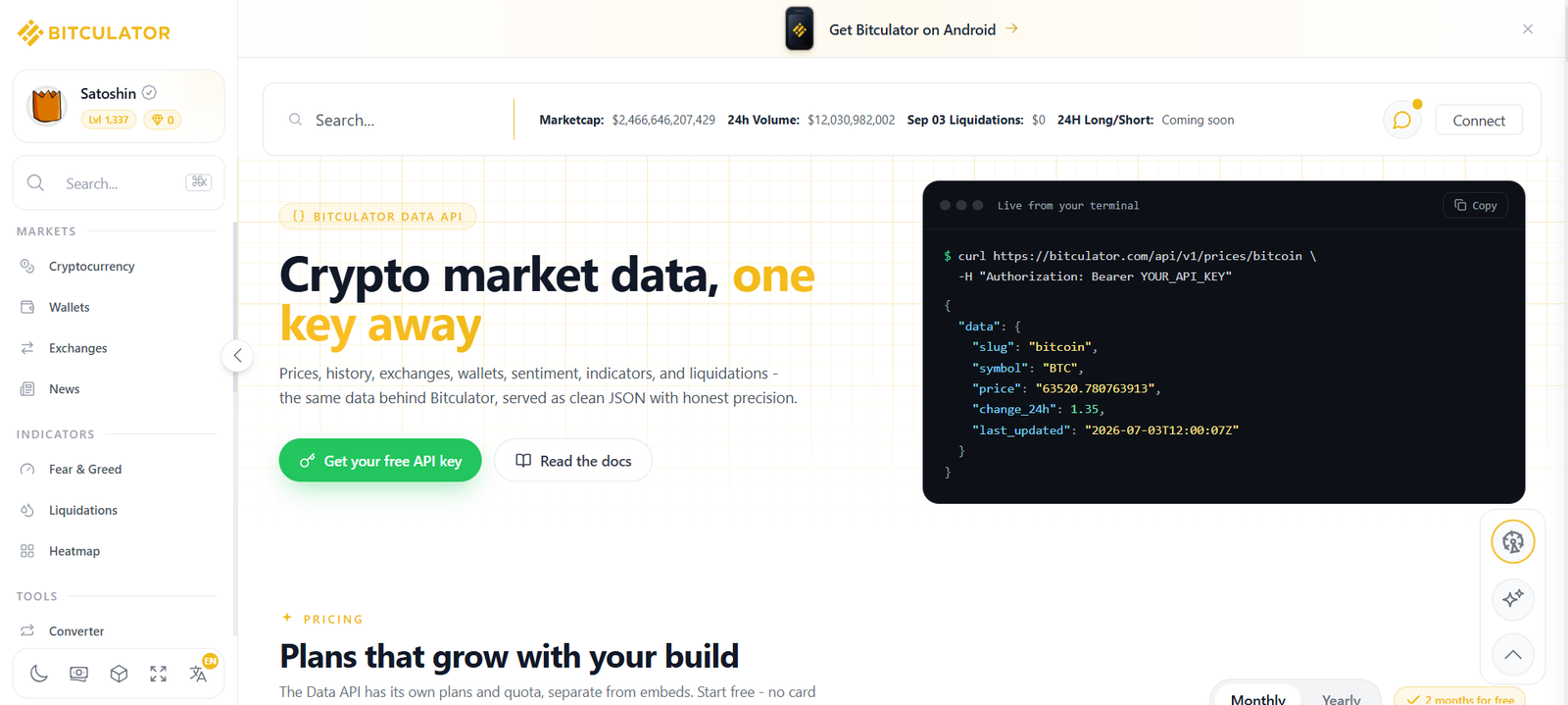
A free plan can be particularly useful during development because it allows developers to test an API before committing to a paid subscription. Bitculator’s Data API, for example, currently offers a free tier with 10,000 requests per month and no credit card requirement, while paid plans provide higher quotas.
Making Integration Easier
Good documentation can make the difference between a quick integration and a frustrating development process. Developers should look for clear endpoint descriptions, authentication instructions, examples, and support for commonly used programming languages.
Bitculator’s API uses standard HTTP requests with Bearer authentication and provides official SDKs for several languages, including TypeScript, Python, PHP, Go, Rust, Java, C#/.NET, and C++.
Final Thoughts
Choosing a cryptocurrency API is ultimately about finding the right balance between data coverage, accuracy, usability, limits, and cost. A simple price endpoint may be enough for a small project, while a larger platform may require historical data, exchange information, sentiment, technical indicators, and other market datasets.
By comparing these factors before starting development, teams can choose an API that fits their current requirements while leaving enough room for future growth.
