

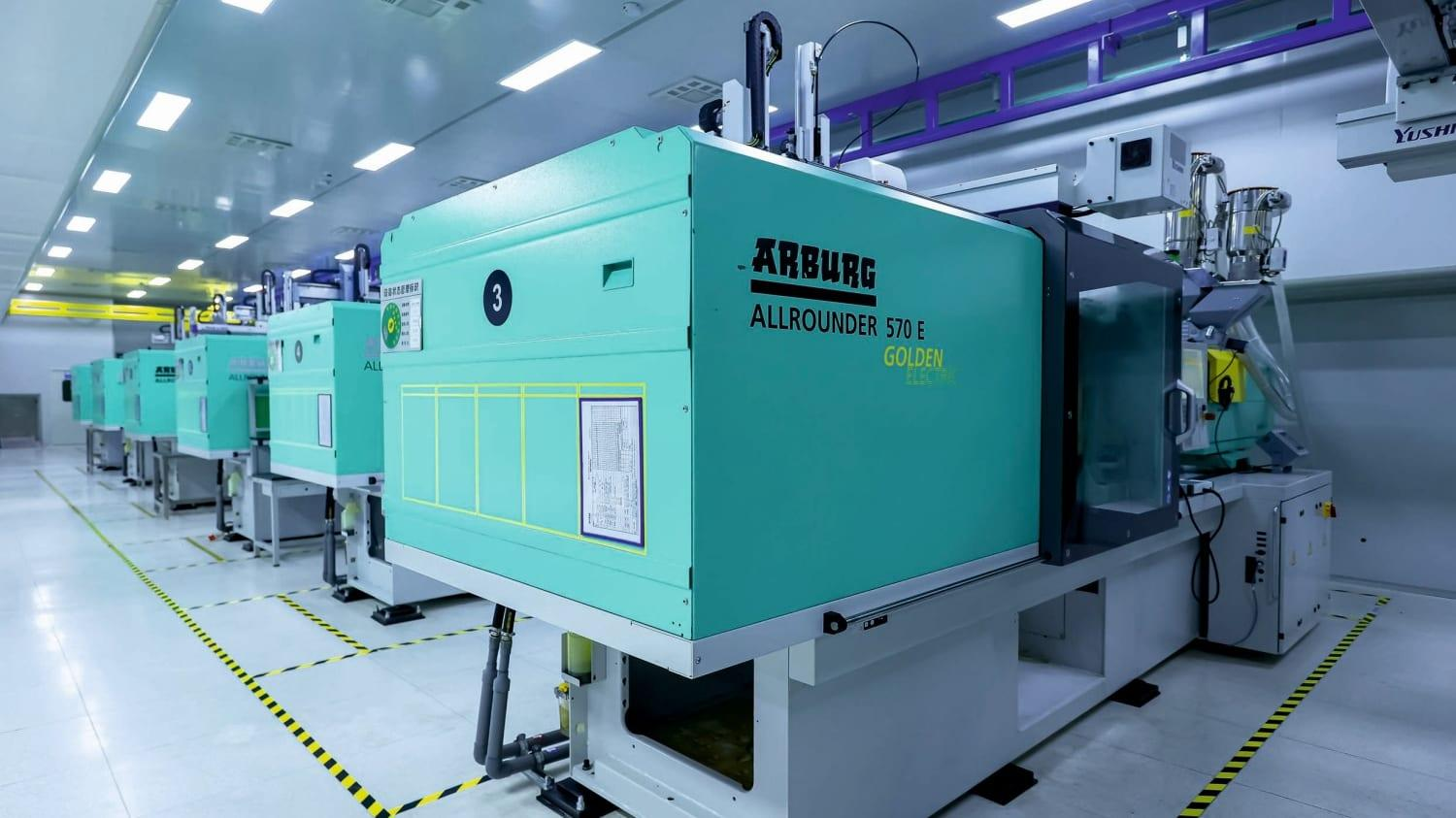
Custom plastic injection molding services help manufacturers produce durable, accurate, and repeatable plastic components for demanding applications. One established plastic injection molding manufacturer is Plastic Molded Concepts (PMC), an ISO 9001:2015 certified company with 50 years of experience in high-precision injection molding, overmolding, and insert molding for industries such as aerospace, medical, and electronics. PMC also supports customers with mold design, material selection, prototype development, forensic failure analysis, and secondary operations, helping companies move from concept to production while maintaining the dimensional accuracy, durability, and quality required for critical plastic components.
What Is Custom Plastic Injection Molding?
Custom plastic injection molding is a manufacturing process used to create plastic parts based on specific dimensions, performance requirements, materials, and designs. Thermoplastic resin is heated until it becomes molten and then injected under pressure into a precision-machined mold.
Once the material cools and solidifies, the mold opens and the finished component is removed. This process can be repeated thousands or millions of times, making injection molding particularly valuable when manufacturers require consistent quality across medium- or high-volume production.
Unlike generic molded products, custom components are engineered for a particular application. Manufacturers can control part geometry, material properties, wall thickness, texture, strength, flexibility, and dimensional tolerances according to the requirements of the finished product.
Why Injection Molding Is Widely Used
Injection molding combines production speed with excellent repeatability. Once tooling and processing conditions are properly developed, manufacturers can produce large quantities of nearly identical parts with minimal variation.
The process also supports highly complex geometries. Features such as ribs, bosses, mounting points, internal structures, and textured surfaces can often be incorporated directly into the molded component.
By reducing the number of separate machining or assembly operations required, injection molding can improve overall manufacturing efficiency while reducing unit costs at higher production volumes.
The Importance of Mold Design
A successful injection molding project begins with effective mold design.
The mold influences nearly every aspect of the finished component, including dimensional accuracy, surface quality, cooling performance, cycle time, shrinkage, and material flow.
Engineers must evaluate wall thickness, draft angles, gates, runners, parting lines, cooling channels, ejector locations, and other design details before production tooling is manufactured.
Poor mold design can lead to defects such as warping, sink marks, flash, incomplete filling, dimensional instability, or excessive internal stress.
Working with an experienced molding company early in the design process can help manufacturers identify these potential issues before they become expensive tooling problems.
Selecting the Right Plastic Resin
Material selection is one of the most important decisions in any injection molding project.
Different plastics offer different combinations of impact resistance, strength, flexibility, temperature resistance, chemical resistance, electrical properties, and dimensional stability.
For example, resin HDPE is commonly considered for applications where durability, moisture resistance, chemical resistance, and impact performance are important.
However, no single plastic is ideal for every component. Engineers need to consider the environment in which the part will operate, including exposure to chemicals, heat, moisture, UV radiation, repeated loading, or mechanical stress.
Experienced molding specialists can help manufacturers compare resin options and select materials that balance performance, manufacturability, and cost.
High-Precision Injection Molding
Certain industries require significantly tighter tolerances than ordinary consumer products.
Aerospace assemblies, electronic devices, medical equipment, and industrial systems often depend on molded components that must fit accurately with other parts.
Small dimensional differences can affect sealing, electrical connections, mechanical movement, alignment, or overall equipment reliability.
High-precision injection molding requires carefully engineered tooling, controlled materials, consistent processing conditions, and detailed inspection procedures.
Modern molding machines allow manufacturers to manage injection pressure, temperature, speed, cooling, and cycle times with a high degree of accuracy.
However, equipment alone is not enough. Process knowledge and experience remain essential when dealing with complex geometries, engineering-grade materials, and demanding tolerance requirements.
Overmolding for Multi-Material Components
Overmolding makes it possible to combine two or more materials into a single finished component.
A rigid plastic substrate may first be molded and then partially covered with a softer material. This approach can improve grip, comfort, sealing, shock absorption, vibration resistance, or appearance.
Overmolding is commonly used for handles, medical devices, electronic housings, power tools, industrial products, and protective components.
The process can also reduce assembly requirements because materials that would otherwise need to be attached separately become integrated during molding.
Material compatibility is especially important in overmolding. The substrate and overmold material must be selected carefully to achieve the desired adhesion and mechanical performance.
Understanding TPE in Overmolding
Thermoplastic elastomers are frequently used when manufacturers want to combine the processability of thermoplastics with flexible or rubber-like properties.
When designing a TPE component, engineers may consider properties such as hardness, elasticity, chemical resistance, bonding behavior, and the TPE melting point.
Processing temperature matters because excessive heat can damage certain materials, while insufficient heat may prevent proper flow or bonding.
Understanding the thermal characteristics of the selected TPE can therefore help manufacturers optimize mold design, cycle conditions, adhesion, and finished-part performance.
Insert Molding for Integrated Assemblies
Insert molding allows manufacturers to place metal or other components into a mold before injecting plastic around them.
Threaded inserts, electrical terminals, bushings, pins, and other elements can become permanently integrated into the molded plastic part.
This process can improve mechanical strength while eliminating separate assembly steps.
Insert molding is particularly useful for electronic components, medical equipment, industrial products, and applications requiring reinforced fastening points or integrated conductive elements.
A carefully designed insert molding process can also improve product reliability by reducing the number of separate components that need to be assembled later.
Injection Molding for Aerospace Applications
Aerospace manufacturers often need lightweight components that can tolerate demanding operational conditions.
Engineering plastics may provide useful combinations of strength, dimensional stability, chemical resistance, corrosion resistance, and reduced weight.
Plastic components can be used in housings, structural elements, electrical systems, interiors, and other specialized applications.
Because aerospace products often operate under strict performance requirements, manufacturers must carefully control material selection, molding parameters, inspection, and documentation.
Working with a molding provider experienced in high-precision parts can help support these requirements.
Medical Plastic Injection Molding
Medical applications frequently require accurate, consistent, and reliable molded components.
Injection molding may be used for device housings, diagnostic equipment, connectors, laboratory components, instrument parts, and other healthcare products.
Material selection becomes especially important because some medical components must withstand sterilization, chemicals, repeated handling, or highly specific operating environments.
Consistent processing and quality control can help manufacturers maintain repeatability across production runs.
Prototype development is also valuable in medical product manufacturing because it allows engineers to evaluate fit, functionality, and assembly before committing to full-scale production.
Injection Molding for Electronics
Modern electronics depend heavily on plastic components.
Housings, connectors, switches, insulators, brackets, protective covers, and internal supports are commonly produced through injection molding.
Materials used in electronics may require electrical insulation, flame resistance, heat resistance, dimensional stability, or chemical resistance.
Insert molding can be particularly useful because terminals, contacts, and other conductive components can be incorporated directly into the molded part.
This can improve assembly efficiency and reduce the total number of individual components in the finished product.
The Value of Prototype Development
Prototype development allows manufacturers to test a component before investing in full production.
A prototype can reveal issues involving dimensions, fit, assembly, material behavior, surface quality, or overall functionality.
Finding these problems early can save significant time and cost.
It is generally easier to modify a design before production tooling is completed than after a high-volume mold has already been manufactured.
Prototypes can also help engineering teams validate ideas, perform functional testing, and obtain customer feedback before production begins.
Forensic Failure Analysis
Not every molding project starts with a new design.
Sometimes manufacturers need help because an existing component is cracking, warping, weakening, discoloring, or failing prematurely.
Forensic failure analysis is used to investigate the underlying cause.
A failure may result from incorrect material selection, poor part geometry, tooling problems, environmental exposure, processing conditions, or mechanical stress.
By examining the failed component and its manufacturing history, experienced plastics engineers can help identify the source of the problem.
Correcting the root cause is generally more effective than repeatedly replacing defective parts without understanding why they failed.
Secondary Operations
Injection molding is often only one stage of production.
After molding, components may require machining, welding, decorating, printing, assembly, finishing, or packaging.
Secondary operations allow manufacturers to transform a molded part into a production-ready component or complete assembly.
Working with a supplier that can coordinate both molding and secondary processes may simplify logistics and reduce the number of vendors involved in production.
It can also improve quality control because fewer handoffs occur between independent suppliers.
Quality Management and ISO 9001:2015
Quality systems play an important role in precision manufacturing.
ISO 9001:2015 establishes a structured framework for quality management, documentation, process control, corrective action, and continuous improvement.
For customers, working with an ISO-certified manufacturer can provide additional confidence that defined quality procedures are being followed.
High-quality injection molding also depends on inspection, process consistency, tooling maintenance, material control, and experienced personnel.
These factors become especially important when producing parts for aerospace, medical, electronics, or other demanding industries.
Improving Product Design Through Manufacturing Expertise
An experienced injection molding partner can contribute during the design stage, not just after the mold is completed.
Design-for-manufacturing analysis can identify ways to simplify component geometry, reduce unnecessary material, improve mold filling, shorten cycle times, or eliminate secondary assembly operations.
A small design adjustment can sometimes prevent significant manufacturing problems.
For example, modifying wall thickness, adding draft, repositioning a gate, or changing a material may improve both quality and production efficiency.
Engineering collaboration before tooling begins can therefore reduce development risk and improve the long-term economics of a project.
Choosing the Right Injection Molding Partner
Selecting a custom injection molding provider involves more than comparing production capacity or price.
Manufacturers should consider engineering support, tooling capabilities, material expertise, quality systems, prototyping services, overmolding experience, insert molding capabilities, troubleshooting support, and secondary operations.
Industry experience also matters. A company that understands the requirements of aerospace, medical, electronics, and industrial products may be better prepared to manage complex tolerances, engineering resins, and critical quality requirements.
A strong manufacturing partner should be able to support the project from early design discussions through tooling, validation, production, and finishing.
Conclusion
Custom plastic injection molding services give manufacturers an efficient way to produce complex, accurate, and durable plastic components at scale. Successful projects depend on the right combination of component design, mold engineering, resin selection, processing knowledge, inspection, and quality management.
Processes such as high-precision injection molding, overmolding, and insert molding make it possible to create increasingly sophisticated components for aerospace, medical, electronics, industrial, and other demanding applications. When manufacturers also have access to prototype development, failure analysis, material guidance, and secondary operations, they can reduce development risks and improve the performance of the finished product.
Plastic Molded Concepts demonstrates how decades of experience, engineering support, specialized molding capabilities, and structured quality management can come together to help manufacturers develop dependable plastic components from concept through production.
