
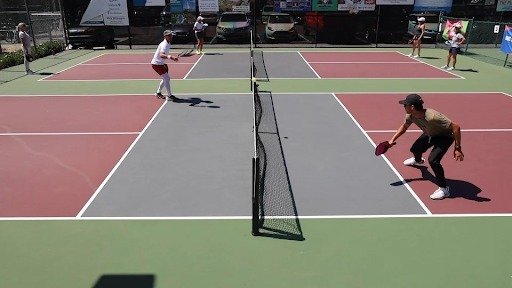
It is the siren song of the pickleball court. You are standing at the kitchen line, engaged in a steady rally. Suddenly, you see it: a sliver of open space directly in front of you, right down the sideline. Your opponent has shifted slightly to the middle. The path looks clear. The glory is calling.
So, you go for it. You lock your wrist and punch the ball straight down the line, aiming for that perfect winner.
But more often than not, disaster strikes. Maybe the ball clips the top of the net tape and falls back on your side. Maybe it sails just three inches wide. Or, perhaps worst of all, you make the shot—only for your opponent to casually step over and blast a sharp-angled volley right past your hip before you can even blink.
You are left wondering: I saw the opening. Why didn’t it work?
The answer lies in the cold, hard geometry of the court. While the “down the line” shot feels aggressive and decisive, it is statistically one of the lowest-percentage shots in the game. In the quest for consistency, falling in love with the line is often the fastest way to lose the point.
The Geometry of Risk
To understand why the straight shot is a trap, we have to look at the physical dimensions of the court. The net in pickleball is not a uniform barrier. It stands at 36 inches high at the sidelines (the posts) but droops to 34 inches at the center.
Two inches might not sound like a lot, but in a game played with a plastic ball that drags in the wind, it is massive. When you aim down the line, you are hitting over the highest part of the net. You are voluntarily accepting a higher difficulty level. You have to hit the ball harder or higher to clear that 36-inch barrier. If you hit it higher, you risk the opponent smashing it. If you hit it harder to keep it low, you risk hitting it long because the court is short (only 44 feet total).
Compare this to the diagonal. When you hit cross-court, you are hitting over the lowest part of the net (the 34-inch center). You have a built-in margin of error. Furthermore, the distance diagonally across the court is significantly longer than the distance down the line. This gives you more court to work with. You can hit the ball with the same pace, but because the diagonal path is longer, the ball has more time to drop in. It is physically harder to hit a ball “long” when going cross-court.
The Angle of Return: Creating Your Own Nightmare
The danger of the down-the-line shot isn’t just about making the shot; it’s about what comes back at you if you don’t hit a winner.
In tactical sports, angles create openings. When you hit the ball straight down the line, you are limiting your opponent’s movement, but you are also opening up the court for them.
Imagine you drive the ball down the line to your opponent’s forehand. They are now standing wide. From that wide position, they have a massive angle to hit the ball back across the court to your partner’s side, or sharply behind you. By hitting down the line, you have given them the entire width of the court to attack. You have effectively stretched your own team’s defense to the breaking point.
Conversely, when you stay in a cross-court rally, the angles remain neutral. You are keeping the ball in front of you. You are making the court “smaller” for the opponent because they have to hit back over the center to get it to you.
The Global Industrial Mindset: Efficiency is Victory
Think of your pickleball game like a Global Industrial logistics operation. In a warehouse, you don’t take risky shortcuts that might result in damaged inventory just to save one second. You build reliable, repeatable processes that minimize error.
The down-the-line winner is the “risky shortcut.” It looks great when it works, but the failure rate is too high for sustainable success. The cross-court soft game is the “reliable process.” It is efficient. It minimizes waste (unforced errors). It forces the opponent to work harder than you.
Winning in pickleball, especially at the intermediate and advanced levels, is rarely about hitting a singular, spectacular shot. It is about forcing your opponent to make a mistake. It is a war of attrition. By constantly directing the ball cross-court over the low part of the net, you are essentially saying, “I can do this all day. Can you?”
The “Reset” Button
This doesn’t mean you can never hit down the line. It just means you have to earn the right to do it.
The cross-court shot is your “reset” button. If you are pulled out of position? Hit it cross-court. If the ball is too low to attack? Hit it cross-court. If you are feeling pressure? Hit it cross-court.
This creates a pattern. You and your opponent engage in a “dinking” battle, gently lifting the ball diagonally over the net. This can feel repetitive, but it is actually a probing action. You are waiting for them to get bored. You are waiting for them to leave a ball slightly too high.
Only when they make that mistake—when they pop the ball up, or when they drift too far to the middle—do you change direction. The down-the-line shot is the punctuation mark at the end of the sentence, not the opening word.
The Psychological Trap of the “Hero Shot”
Why is it so hard to resist the line? It comes down to ego and the “Hero Shot” mentality. We want to be the one who ends the point. We want the applause. Hitting a safe diagonal dink doesn’t feel like being a hero; it feels like being a role player.
But the best players in the world are excellent role players until the exact moment they need to be heroes. They understand that patience is a weapon. They use the cross-court rally to hypnotize their opponent, lulling them into a rhythm, before snapping a shot into an open gap.
If you watch professional play, you will see that 70% to 80% of the shots at the kitchen line go cross-court. They aren’t doing this because they lack the skill to hit down the line. They are doing it because they understand the math. They know that whoever changes the direction of the ball first usually loses the point, unless they have a perfect opportunity.
Conclusion
The next time you are on the court, challenge yourself to ignore the siren song of the sideline. Resist the urge to be the hero on every shot. Embrace the geometry. Trust the center of the net.
When you stop looking for the quick winner and start looking for the smart setup, the game slows down. You stop feeling frantic. You start to see the court not as a place to run, but as a puzzle to solve.
By mastering the patience required to sustain a diagonal rally, you are building the foundation of a 4.0+ game. You are moving away from “checkingers” and playing “chess.” If you are ready to learn the specific mechanics—the footwork, the paddle face angle, and the “lifting” motion—that make this strategy possible, diving into a comprehensive guide on the Pickleball Cross-Court Dink Technique is your next logical step. Until then, remember: the long way home is often the safest.
